Why some of us are bad at maths
This post was originally written in May 2018 and updated in July 2026.
Back when I was a psychology researcher, I used to successfully use maths quite a lot, largely for statistics. However, I also recall teaching a class where we’d been counting up answers to some kind of questionnaire. I had to do a fairly basic sum like 63 + 74 = ? and I suddenly couldn’t do it. This has happened to me on and off throughout my life. Some other people experience this kind of difficulty with numbers constantly and at a much greater depth than I did, and some people will never have a moment’s hesitation even with complex mental arithmetic. Why?
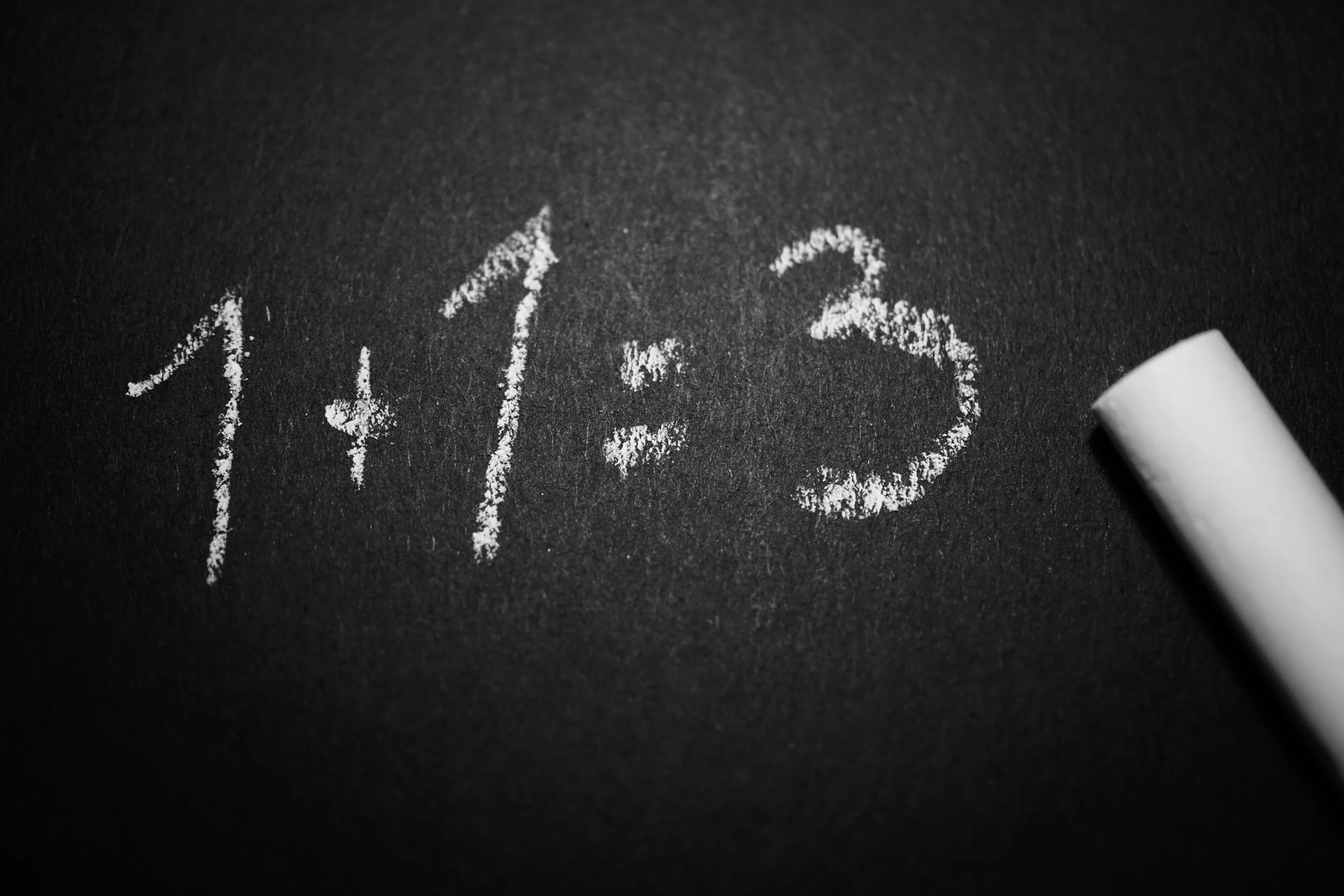
Yep, I did more or less this, in front of a class. One of them helpfully yelled out the answer. Thank you, whoever you were.
The answer is a two-parter. All of us exist on a continuum from maths genius to I don’t get numbers at all, because humans tend to vary in their capacity to do intellectual tasks like mathematics, reading and drawing. There are also some people who have dyscalculia, a learning difficulty which makes it extremely hard to understand numbers.
Why is there a continuum?
This is a very complex question because there are a lot of different factors involved.
These might be factors inherent to you, like how good your working memory is.
Working memory is the part of your memory that holds and manipulates temporarily-needed information. When you’re making a cake, your working memory might contain the thoughts: the recipe says I need the baking powder, where do we keep the baking powder, is this baking powder or baking soda, where's the measuring spoon, I'm sure I had it a second ago.
While I am finding the measuring spoon, please do the sum 842 - 57 in your head.
…You used your working memory to do this sum. You might have pictured the numbers written in front of you, as though you were writing the sum on paper, or you might have said the numbers to yourself as you were calculating, or if you’re like me, you picture the numbers as a line in space and kinda shuffle along the line.
Imagine if you had a much better working memory than you do – you’d be quicker, right? Or if you had a much worse working memory, you might have to write down the sum so you had an external reminder of what step you were on. This tells us that because we differ in how good our working memories are, we also differ in how easily we can do maths.
However, factors like these that are to do with deep individual differences are probably not the main driving force behind differences in our maths ability. Tosto and colleagues looked at how similar identical and fraternal twins are in their basic numeracy abilities, and found that most of the variation in how good an individual is at these things can be explained by environmental factors, not genetic ones.
So let’s consider those environmental factors, like your age, your gender, your nationality, and your socio-economic status. Please note that it’s not being a certain age, gender, nationality or class that explains your maths ability, but rather the social context of belonging to a particular group.
For example, if you live in rich nation (in the sense of having a high GDP) like Germany, you may be more likely to have access to schooling than someone living in a poorer nation like Montenegro. And if we look at fourth-grade maths scores in Germany, they are much higher than the international average, while fourth-grade maths scores in Montenegro are lower than the international average.
(Yes, there is an international average maths score for fourth-graders, and also one for eighth-graders. These, and the scores for Germany and Montenegro and other individual countries, come from the Trends in International Mathematics and Science Study, or TIMSS. The TIMSS is a worldwide research programme run by the International Association for the Evaluation of Educational Achievement (IEA) and has been assessing fourth-graders’ and eighth-graders’ mathematical abilities every four years since 1995. The most recent one was in 2023.)
But it’s clearly not only money that explains this, because the average scores for American fourth-graders are lower than those of German fourth-graders - and the USA is the richest country in the world by GDP. So we also need to think about other factors, like what kind of teaching styles are being used in mathematics lessons, how (much) your maths learning was interrupted by Covid, and how (much) your caregivers talk with you about maths.

“Do you know how many hours of uninterrupted sleep Mummy has had since you were born, Celeste?”
What about gender? Well, we can look at the TIMSS for that, too.
In 2023, fourth-grade boys scored higher than fourth-grade girls on the TIMSS in just under 70% of countries, while the remaining 30% had no gender gap. There was only one country, South Africa, in which girls scored higher than boys at this age, though I don’t know why that is.
The gender difference in maths scores is less stark in the eighth grade. At this point, only 50% of countries have boys scoring higher than girls, 40% of countries have no gender difference, and eighth grade girls in South Africa, Palestine, Oman and Bahrain are all scoring higher than boys. (While it’s good to see the gender differences evening out, these stats still make me a little sad, especially because when I originally wrote this article the most recent scores available were from the 2015 TIMSS and at that time many more countries had no gender difference in maths scores.)
There is hope, though. Women used score worse on maths tests than men, but as of 2014 this was no longer the case, which is great news considering that in many countries there’s been a long and sexist history of it being “improper” for anyone other than men to be good at maths and consequently a long and sexist history of men being described as “better at maths than anyone else” (when it would have been more accurate to say they were “getting more education in maths than anyone else”).
However, there is still the problem of stereotype threat: when you are reminded that you belong to a group that is stereotypically bad at a particular task, then you’ll respond by becoming worse at that task. For example, if someone told me “women are bad at maths” just before I did a maths test, I might do worse than a version of me who'd not been told that. Of course, I might not do worse. Though I am female and other people perceive me as such, it's not a strong aspect of my identity. I don’t feel like I have very much gender, for want of a better phrase. I've noticed one big advantage to this - when someone is sexist, while I get angry about the injustice, it doesn't feel particularly personal. I suspect that it might be quite hard to get me to display gender-related stereotype threat. (And here we’re getting into another important challenge, which is that we don’t yet know much about nonbinary people’s maths abilities because researchers have tended to treat gender as a binary thing.)
Even if I did respond to stereotype threat, it would be quite hard to say why. Is it that despite my expectations, I've bought into the stereotype and am changing my behaviour to meet society’s expectations? Is it because my anger about someone being sexist is distracting me? Is it both of those? Is it something else entirely?
It's probably now becoming clear that it’s really hard to pick apart why there is such a range of maths abilities among humans. This complexity causes a difficult and important practical problem in the UK (and probably many other countries, but I’m using the UK as an example as it’s the country I’m most familiar with). At the age of 16ish, almost everyone in the UK sits exams called GCSEs (or Nationals, if you’re in Scotland). Your grades in GCSE or National Maths and English determine what types of further education and training you can then go on to access. Which isn’t very fair because, you know, what if you’re a girl and someone reminds you that girls are stereotypically bad at maths just before you go into the exam? What if you’re at a state school rather than a fee-paying school? What if you’re simply having a bad day when you sit your exams?
We can try to make the tests fairer, of course, but given how many things can affect performance on tests in maths (and other subjects), the answer might not be about making the tests fairer but instead finding different ways to assess maths ability and/or broader acceptance of the idea that it's okay not to be good at maths. And that would really help people who have…
Dyscalculia
Some people – around 7% of us – find maths difficult because of a developmental disorder called dyscalculia. Dyscalculia is a mathematical learning disability: you might be very intelligent and have access to good all-round teaching, but still struggle to learn maths. In this regard, it’s very like dyslexia, where someone finds reading much harder than you’d expect from how they do with spoken language, like understanding verbal instructions from a teacher.
It’s not really clear why dyscalculia happens. Part of the problem with figuring out what’s going on is that there seem to be lots of different systems that deal with numbers in the human mind. Let’s take a quick look at how the numeracy expert Brian Butterworth breaks these down:
The approximate number system
This allows us to estimate roughly how many of something we can perceive. For example, you can probably make a guess at approximately how many piranhas are in this picture without counting.

I counted. The number of piranhas is Too Many.
(Side note: piranhas themselves can probably also estimate numbers in the same way as we do, though they can’t communicate that estimation to us… unless that's what all the biting is about.)
Mazzocco and colleagues believe that dyscalculia is caused by something to do with the approximate number system. They asked some 14- and 15-year-olds to do a bunch of different maths tasks, including one which relied on the approximate number system. This task involved looking quickly at a group of yellow dots and blue dots, then saying whether there were more yellow dots or blue dots. The teenagers who had dyscalculia also did poorly on this task.
However, difficulties with the approximate number system don't show up every time researchers test people with dyscalculia. And even when they do, we can't be sure that we've got the causal relationship the right way round. Having difficulties with the approximate number system might also happen as a consequence of dyscalculia. Your dyscalculia may mean you don't get as much practice at using numbers as others. That could be because your teacher hasn't realised you have dyscalculia and is giving you work that’s far beyond your current understanding. But even if you’re getting work that is appropriate to your level of understanding, it may take you more time to do the same maths work. Let's imagine that you have three maths lessons a week. In a typical maths lesson, you get three practice problems done, but your classmate who doesn’t have dyscalculia gets ten problems done. After a week, they've done 21 more practice problems than you. After a 13-week term, they've done 273 more. After a year, they've done over 800 more practice problems than you.
So if we can't be certain what's going on with the approximate number system, what about the other ways our brains deal with numbers? How might they fit with dyscalculia?
The small number system
Earlier, I asked you to estimate roughly how many piranhas there were at a glance. Interestingly, if we’re dealing with a very small number – under about 5 – it’s usually possible to tell exactly how many things there are at a glance. This ability is called subitizing, and it’s pretty cool because it tells us that humans deal with small numbers and large numbers in different ways.
Children with dyscalculia have problems not just the numbers up to 5, but the whole range from 1 to 9. On the face of it, that discounts difficulties with subitizing. However, if something about your small number system is making it hard to deal with quantities up to 5, that’s a fundamental building block of numeracy that's a bit wobbly. That wobbliness could then affect the later building blocks, making it harder to work with bigger numbers as well.
At the moment, it seems we can't be sure whether this system plays a role. Let’s try one last system.
The numerosity coding system
There’s a picture of some pencils below. I’d like you to count how many there are. (If you’re using a screenreader, the alt text should tell you how many there are.)

Twelve colouring pencils
Great! You have just found out the numerosity of the pencils – that is, the number of items in the set of things you are counting. You might remember learning to do this as a toddler, or maybe you’ve recently taught a toddler how to do it. As an adult, you know that numerosity can come ‘unstuck’ from the set. That is, it’s perfectly possible to use the number 12 again for another purpose, like describing how old someone is, how many days of holiday you have left to take this year, or how many dogs is the perfect number of dogs (though you would be wrong about the last one because the perfect number of dogs is infinity; speaking of which, here is an impromptu dog montage).






Now that you have refreshed yourself with those good boys and girls, back to the point.
Imagine you couldn’t figure out numerosity correctly, no matter how many or how few items you had. It would disrupt even the fundamentals of maths, right? You wouldn’t be able to tell how many of anything you had, and you’d also get knock-on effects when you tried to do maths: 2 + 3 might be 5, or it might be 17.
Brian Butterworth thinks difficulty with numerosity is the core problem for people with dyscalculia. There is a decent amount of evidence to support this idea. For example, children with dyscalculia have trouble with figuring out numerosity in a way that children without dyscalculia do not.
But… in psychology when you ask, “What causes this behaviour/change/difficulty?” the answer is almost always, “Many different things!”
So is it just diffuculties with numerosity that drive dyscalculia? Nope! Children with dyscalculia have problems with the approximate number system, but also with the small number system and with working memory.
A final, hopeful thought
If you are bad with numbers, don’t despair: it may be possible to reduce the effects of dyscalculia through games that train you to be better at counting and manipulating numbers. And if you are good at maths, don’t be too smug: it’s largely the environment you’re in that’s made you that way!
Got a question that only psychology can answer? Talk to me!