Do people really behave strangely at the full moon?
Many thanks to my parents for inspiring this question. It came up when my dad, who had been using a sleep quality app for several months, noticed that he slept much less well at the full moon than at the new moon. He wanted to know why I thought that was.
While I was thinking about it, I mentioned the idea to my friend Emily, a former medic, who told me that there’s a common belief among Western medical workers (though not necessarily medical workers in other cultures) that unusual behaviours are at their peak during the full moon, causing more weird shit to happen in the emergency departments of hospitals.
Is it true? Let’s find out!
First of all, when we say ‘unusual behaviour’, what might we mean? There are lots of possibilities, but I’m going to focus on three: mental illness being heightened at the full moon, people being more violent at the full moon, and sleep being worse at the full moon.
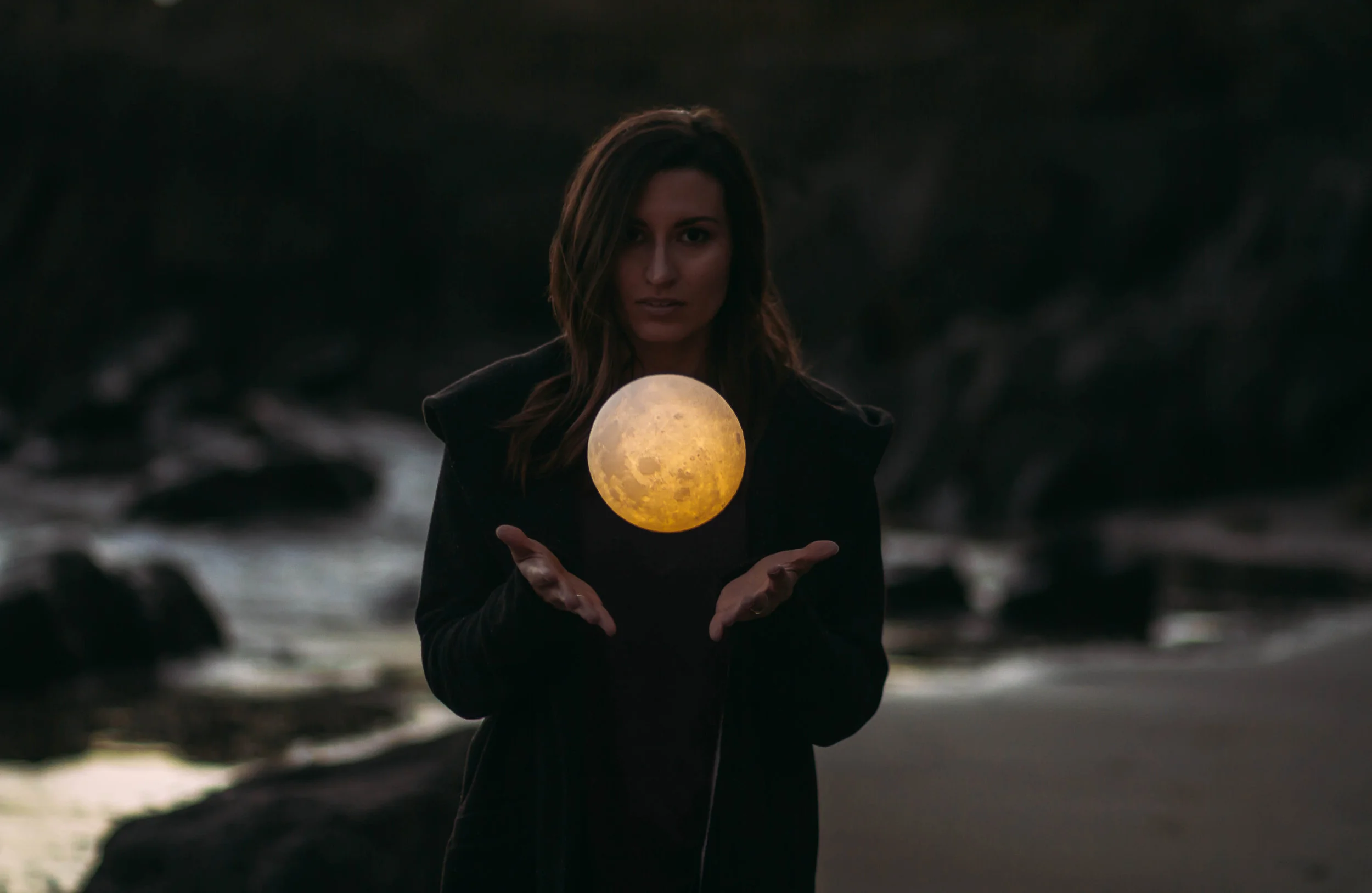
Other known moon-related behaviours include howling, menstruating, and [checks notes] using telekinesis to turn it into a fun toy???
Mental illness and the moon
One difficulty about asking whether mental illness is worse when there’s a full moon is that there are lots of different ways in which one can be mentally ill. I have anxiety, which is one type of mental illness, but I also know people with depression, post-traumatic stress disorder and eating disorders. I imagine I also know people who haven’t told me about their mental illness, because of the stigma associated with it – this is particularly likely to be the case for psychotic mental illnesses like schizophrenia, where being open about a diagnosis can mean that others wrongly believe you are dangerous, incompetent, or unfit to be a parent.
We might also want to consider that an “episode” of mental illness could be quite difficult to define because of this variety in what mental illness actually is, and because it manifests differently for different people.
So, bearing in mind these problems, I tried to include a fairly broad swathe of mental illnesses when I was reading about the research in this area.
McLay, Daylo and Hammer evaluated psychiatric admissions to the Naval Medical Center in San Diego over an eight-year period – over 8,000 in total. Helpfully, they also divided the admissions into different types: psychotic (that’s schizophrenia and similar illnesses), mood disorders (that’s depression and its friends), anxiety disorders (I’m sure you can guess what this one is) and other disorders (this is a pretty large category, which as far as I can tell included eating disorders, substance abuse, amnesia and personality disorders, among other things). What did they find? Nothing. Neither overall, nor in any of the four types of admissions, did they find any variation in admissions across the lunar cycle.

“Uh, Houston? The moon sounds like it’s saying werewolves aren’t real.”
Okay, that’s one hospital in the US. What about other hospitals elsewhere?
Well, it’s a fairly unequivocal picture.
In Italy, no relationship between moon phase and contact with psychiatric services.
In Kuwait, no relationship between moon phase and attendance at a psychiatric emergency room.
I think we can probably write this one off as a myth.
Violence and the moon
One of the first pieces of research I found in this area was a study from 1984 by Thakur and Sharma, who investigated the incidence of crime across four years in the state of Bihar in India. They found a sharp rise in crime at the full moon compared to other times of the month, and attributed this to a sort of human version of tides. While I am a little sceptical about this theory, humans do have other regular rhythms, like the circadian rhythms that get disrupted in jetlag, so… maybe?
The thing is, when I looked for other studies I once again pulled a very near blank – though admittedly almost every study I could find was done in the US, which is a fairly narrow slice of the world’s population. Nonetheless:
No increase in violent behaviour among inmates in a US prison at the full moon.
No uptick in hospital admissions related to violent crime in a US hospital at the full moon.
But I did find one study which showed that that as the moon waxed each month in San Antonio, Texas, drugs-related crime became less frequent, and burglary became more frequent.
I can’t explain the drugs, but I suspect I know what’s going on with the burglary: the full moon is a useful burglary accomplice on clear nights. Its light could help you see what you’re doing more easily, but it’s not so intense that your activities are obvious to others. With luck, anyone who sees you will assume you’re doing something fairly innocuous, like making an illicit midnight visit to a lover.

The moon, getting ready for a night of abetting burglars.
Sleep and the moon
Do you know, I think my dad was right about sleep quality?
Röösli and colleagues asked people in and around Basel, Switzerland, to keep track of their sleeping habits each night for a couple of months. Now, I love me a graph, and I tell you I nearly wept with joy when I saw the graph they had made – sadly I can’t reproduce it here for copyright reasons, but you should go and have a look at Figure 1 at the link above. It’s a beautiful wave-like pattern, with a peak in the number of minutes of sleep per night at the new moon, and a dip at the full moon.
What’s that you say? Oh, you think people might be lying, perhaps inadvertently, about how much sleep they’re getting because they’ve bought into a myth about a link between sleep quality and the phase of the moon?
You bet your sweet bippy they could! This is called a demand characteristic, and it is a mortal enemy of research psychologists.
Luckily, some researchers have access to polysomnographs, machines that record how well someone is sleeping based on things like muscle activity, heart rate and eye movements. Turányi and colleagues used polysomnographs to record the sleep of over 300 people who were attending a sleep clinic because of a suspected or actual sleep disorder – and they found, again, that sleep is worse at the full moon than at other times of the month. This should not be taken as conclusive evidence, partly because they were testing a group of people who have disturbed sleep, and partly because they weren’t asking people to come in for multiple nights. Instead, they compared the people who’d come in on the full moon with people who’d come in at other lunar phases. Though it’s unlikely, this does mean it’s possible that the people who had worse sleep problems coincidentally came to the sleep clinic at the full moon.
It’s also important to be aware that not everyone looking at moon phase and sleep quality has found a relationship, and that it’s much easier to get a study published in a journal if you find an interesting result like the phase of the moon affects sleep! than if you find an uninteresting result like the phase of the moon doesn’t affect sleep! (This difficulty with getting boring findings published is called publication bias, and it is another mortal enemy of research psychologists, because boring is not the same as unimportant.)
One other possible reason for these contradictory results about the moon and sleep is that people differ in where and when they live and sleep. My parents live in the middle of nowhere, and my dad has told me a few stories about walking the mile back from the local pub lit both internally (by several beers) and externally (by the moon). This is pretty unusual for modern humans. We tend to gather in cities, which these days are brightly lit enough to drown out the moon. If we went back to the days of candles, or even further, then the moon would be a major light source, perhaps enough of one to wake you up the same way that the sunrise can.
So why do we believe the full moon affects behaviour?
Well, some weird behaviour might be explained by lack of sleep, since there seems to be more evidence for that than for episodes of mental illness or increased violence. I’ve done some very silly things after a sleepless night. I’ve also believed some very silly things after a sleepless night, which brings us to the idea of confirmation bias.
Let’s say that you strongly believe that the full moon brings out weird behaviours, or that the Earth’s surface was once fully frozen, or that the Loch Ness Monster exists, or hold any other belief for which there’s no conclusive evidence.
Confirmation bias means that you are much more likely to look for evidence that your belief is true than that it is false. When you find inconclusive evidence, you will tend to interpret it as supporting rather than disproving your belief. When you are asked to list evidence for one side of the argument or another, you will mostly recall evidence that supports your belief.
With the belief Full Moon = Weird Time, you’re therefore going to recall the one person who bit a colleague at the full moon, but you’re much less likely to recall the thousands of other people you met on a full moon who did not sink their teeth into anyone’s hand.
Similarly, if you enter an environment where a lot of people hold a particular belief – like a hospital where the staff largely believe that the full moon brings out the worst in people – you are going to have a hard time fighting off the weight of that belief.
A classic example of this is an experiment about judging line lengths from all the way back in the 1950s. The researcher got people to look at a line we’ll call A, then at three other lines we’ll call B, C and D. All the participants had to do was judge whether B, C or D was the closest in length to A.
I say “all they had to do” because there was always an extremely obvious right answer – but people frequently gave the wrong answer.
Why? Because they were giving their answer out loud in front of several other people, all of whom had been instructed to give the same wrong answer.
This response to social pressure is very helpful for social cohesion – it’s nice when people agree with us, because then we don’t have to argue! – but it is not necessarily very helpful if you want a correct answer to a question.
I’m not going to tell you that it’s a great idea to go round disagreeing with any majority you find, because majorities aren’t always wrong.
Just remember you don’t have to trust anyone’s opinion just because they’re a doctor. Trust me, I’m a doctor.

Nessie 4 lyf