Why are people superstitious?
This article was originally published in October 2018 and updated on Friday 13th February 2026 (yes, I picked that date on purpose).
Did you know that pigeons can be superstitious? Seriously!
Back in the day, there was a psychologist called B. F. Skinner, who was very interested in conditioning. No, not the thing that comes after shampooing – this is what psychologists call the process of trying to modify a behaviour.
If you have a dog, you’ve probably used conditioning as it’s a great way to help them learn that sitting, staying, or walking to heel will result in a ✨reward ✨! Because the dog doesn’t know what you want them to do to start with, if you’re teaching them something like “shake” you need to go in slow steps. You might at first give them a reward for sitting very briefly. Later, as they get more familiar with what you want them to do, you might only give them a reward after they’ve sat for two seconds, then only if they sit for more than two seconds and lift their paw, and so on, until at last you get to sit + lift paw + shake.
Skinner wasn’t so big on dogs; instead he used rats or pigeons, presumably because they take up less space and are cheaper to feed… and probably also because Skinner was doing some pretty mean things sometimes and most people feel worse about being mean to a dog than to a rat or a pigeon.

Delegates at the 70th annual meeting of the B. F. Skinner Hate Club and Avenger Squad
Most of Skinner’s less-mean experiments involved getting the pigeon to do something like press a lever in exchange for food, but in 1948 he decided to see what happened if he just gave pigeons a bit of food at regular intervals, with no action required on the pigeon’s part. After a while, he noticed that the pigeons were developing strange behaviours, like swinging their heads. These behaviours could evolve over time to become more elaborate: swinging the head to the left became turning to the left became hopping to the left while turning.
Like the dog who’s learning to sit and give their paw, the pigeon had started to develop something like a belief (though it’s hard to say if it’s a belief in the same way that a human would have a belief), that they needed to do more and more complex things in order to get their food. However, unlike the dog, the pigeon wasn’t actually being given a reward because of their behaviour. They would get the food no matter what they did.
The pigeon’s belief is something very close to a superstition – an incorrect link between cause and effect that persists even though evidence suggests.
Superstitions come in two types
The pigeon is displaying a positive superstition: if I behave in this way, something good will happen. For humans, an equivalent superstition might be thinking that four leaf clovers are lucky.
We (and presumably pigeons) can also have negative superstitions: if I behave in this way, something bad will be prevented. As someone who is anxious a lot, I have a great affinity with negative superstitions. I salute every magpie I see, if I spill salt I throw it over my shoulder, and (one I picked up from my dad, formerly in the Merchant Navy) if I accidentally hit my glass with my cutlery, I will instantly mute the ringing with my hand lest some poor sailor die.

Formal dinners and the associated glassware are an absolute fucking minefield for me
Superstitions evidently have value for me, because they help me feel like I am in control of things I am not actually in control of. But…
Where did superstitions come from?
Along with lots of other species, humans probably evolved superstitious behaviours or beliefs because there are massive advantages to correctly linking cause and effect that outweigh the disadvantages of false alarms.
Consider a superstitious belief like ‘you won’t catch any fish if you take bananas aboard a boat’. If the superstition is wrong, well, then there are other things you can eat and there are probably going to be bananas when you get back on land again. If the superstition is right, though, then having bananas on board could mean that your trip is wasted and that you don’t have any fish to sell or to eat, a scenario with much worse potential consequences than simple lack of banana. Better to be safe and not take the bananas on board. If you want a more in-depth view, here’s a paper that explains the maths.
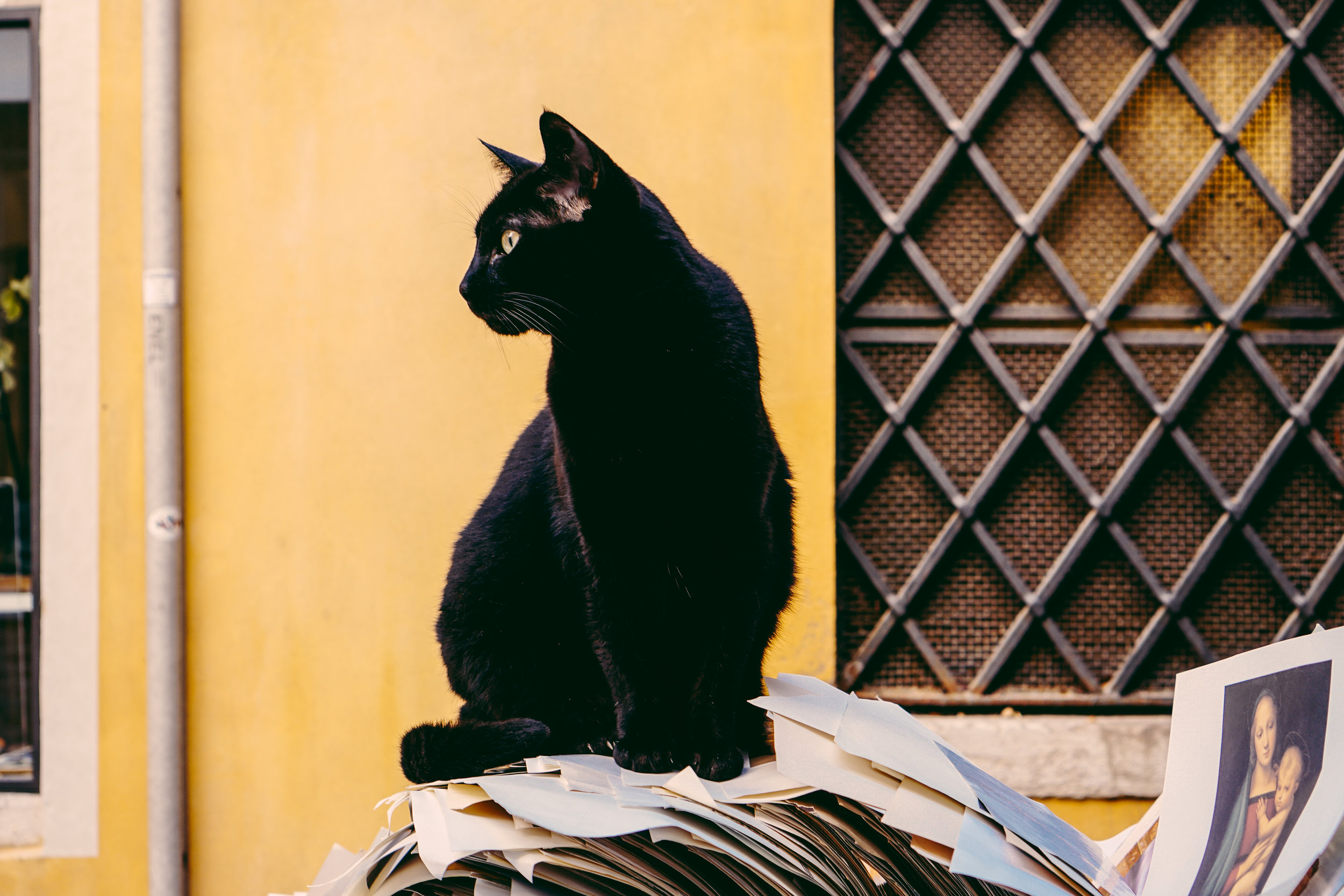
Did you know black cats are traditionally considered lucky in the UK and Japan, unlucky in the USA, and somewhere in between in Germany?
What is going on in our minds when superstitions happen?
Rationally speaking, I know that my glass ringing cannot possibly cause the death of a sailor, and yet I still mute it with my hand. Why would I do it if I don’t believe it’s effective?
To understand, first we need to talk about a model of decision-making that psychologists Daniel Kahneman, Amos Tversky and their collaborators developed over many years. The central idea of this model is that humans have two systems of thinking, both of which are useful in different ways:
System 1 is fast but prone to errors, because it relies on emotions and stereotypes.
System 2 is slow but more accurate, because it requires logical reasoning and effort.
The behavioural scientist Jane Risen built on this idea by exploring how we might react when System 1 makes an error. She suggests three types of reaction:
We don’t realise that the System 1 belief is wrong, so we accept it.
We realise that the System 1 belief is wrong, so we correct it.
We realise that the System 1 belief is wrong, but we don’t correct it: we acquiesce to it - this is where superstitions arise.
Risen thinks there are certain circumstances that make us more likely to acquiesce to wrong System 1 beliefs. One such circumstance is that the belief is is particularly compelling. Another circumstance is that the cost of wrongly deciding that your belief is irrational is very high.
It’s easy to see from this point of view how the glass-ringing-sailor-dying superstition might spread among sailors and their loved ones: thanks to personal experience, they know lots of sailors and they know just how dangerous a sailor’s life is. If you don’t work in a dangerous job or know anyone who does, just imagine for a second that you do. Imagine that you’ve been told there’s a ritual that can help ensure safety. Logically, you know that the ritual cannot possibly make things safer - but would you stop doing it unless you were absolutely certain that there would be no bad outcome? Would you tempt fate? I wouldn’t.
Something cheerier: when superstitions have positive effects
As far as I know I have never saved a sailor from dying thanks to my ringing-glass superstition, or averted bad luck by saluting a magpie or knocking on wood or not wearing new socks on a long car journey. (I made up that last superstition all by myself - thanks, anxiety!)
But I do know that carrying out a superstitious behaviour can make you feel more in control of events in your life. This can be very useful! Not just for me, an anxious person with cool new socks she’d quite like to wear even though she has to drive to Cornwall. But likely for people in all kinds of high-stakes or nerve-wracking situation. Professional athletes. Exam-takers. Firefighters.
How does superstition help? To understand, let’s look at an experiment in which the researchers asked students at a German university to complete a variety of tasks, including memory tests and anagrams. Each person was asked to bring a personal good-luck charm to the experiment, which was then taken away to be photographed before the task. Some people got their charms back before the task, and some people got them back after the task. Those who had their lucky charms with them when they were doing the tasks were more likely to believe that they would succeed at the tasks than those who didn’t have their lucky charms – and they were right. The researchers found that this better performance was because participants set higher goals for themselves before the tasks and kept trying at the tasks even when they were struggling. All this from just having a lucky charm nearby.

[Dad joke face] Do you think a Coco Pop would have the same effect as a lucky charm?
Superstitions are clearly just in our head, but they just as clearly have real effects on how we interact with the world. So I guess my advice is this: if you have a positive superstition, it probably won’t do you any harm to act as though it can actually affect the world around you. Just, uh, leave the rabbit’s foot on the rabbit. It needs the foot more than you do.